Scars form as a result of the wound healing process after surgery and injuries.
Why should a scar be treated?
Pre-operative treatment
When can a scar be treated?
Pre-operative treatment
Scar treatment after an operation
about me
For more than 15 years, I have been working with great fun, enthusiasm, and passion in the physical therapy field.
The complexity of anatomy, physiology, and the interrelationships of the body fascinate me greatly, which is why I strive to continually expand my medical knowledge and further train my hands through continuing education.
During my studies and various further training courses at home and abroad, I have learned different approaches to osteopathy, which have significantly expanded my osteopathic horizon.
career
2009 State-recognized occupational therapist
2011 certified hand therapist
2019 Bachelor of Science, The International Academy of Osteopathy, Belgium
2022 Master of Science, Osteopathie Schule Deutschland
2022 Obtaining the license to practice naturopathy
Continuing Education
During my work as a therapist, I have participated in numerous further training courses, including:
- Urogenital Manipulations for Female and Male Pelvic Disorders, Parts 1 and 2 – Olivier Bazin D.O.
- Neuroendocrine dysfunctions; Osteopathic approach – Nathalie Camirand D.O.
- Since 2024 course series: Uro-Gynecology & Obstetrics, OSD in cooperation with the Camirand Muzzi Institute
- Narbentherapie according to the Liedler concept
- Scar treatment according to the S.O.F.T. concept (scar-oriented functional therapy concept) – Nils Bringeland
- Dry Needling – DGSA®
- Building block series for certified hand therapist (AfH),
what is important to me
Consideration of the patient's wishes
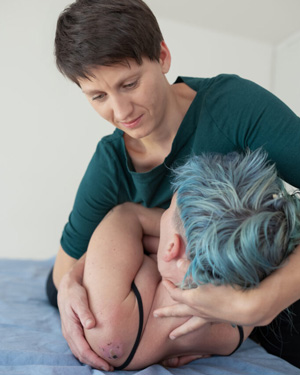
The human body is fascinating, with many different structures and functions that are closely interconnected. The emotional situation and personal experiences also play a significant role, as they have a strong impact on the body. Therefore, I design the treatment to be completely individual to best support you in your entirety.
Involving patients
During treatment, it is important to me to involve the patients. For a sense of one’s own body, understanding, and a transparent overview of relationships enable solutions and an individual approach to abnormalities or pain. I’m happy to take the time to explain the relationships between anatomy and physiology in more detail.
Consensus and awareness in my work
Every person has had different experiences with themselves and their own body and knows themselves best. In my examinations and treatments, I find it important to have a consensual approach, in which the boundaries of my patients are respected and decisions about treatment are made together.
I am aware that people can be affected by various forms of discrimination and may have had negative experiences in the healthcare system. I try to be sensitive to this. If there are any topics or wishes, I am always available to discuss them.
Interdisciplinary work
Telefon: +49(0) 178 1887520 | E-mail: info@osteopathie-kreuzberg.com